Why You Should Never Place a Mirror Facing Your Bed in Feng Shui
A mirror facing your bed is one of the most common feng shui mistakes. Here's why it disrupts sleep and energy, and how to fix it without renovating.
If you’ve read anything about feng shui and bedrooms, you’ve likely come across the same warning again and again: never sleep with a mirror facing your bed. It’s one of the most consistent, most repeated rules across different schools of feng shui practice — which is unusual, since feng shui guidance often varies quite a bit depending on the tradition and practitioner.
That consistency is worth paying attention to. If you have a mirror facing your bed right now — a dresser mirror, a mounted wall mirror, a mirrored closet door — this is what the concern is actually about, and what you can do about it without a renovation.
Unlike some feng shui guidance that requires a trained eye or a full bagua map reading, this particular rule is refreshingly simple to check and simple to fix. You don’t need to know anything else about your home’s energy layout to apply it.
Why This Rule Shows Up So Consistently
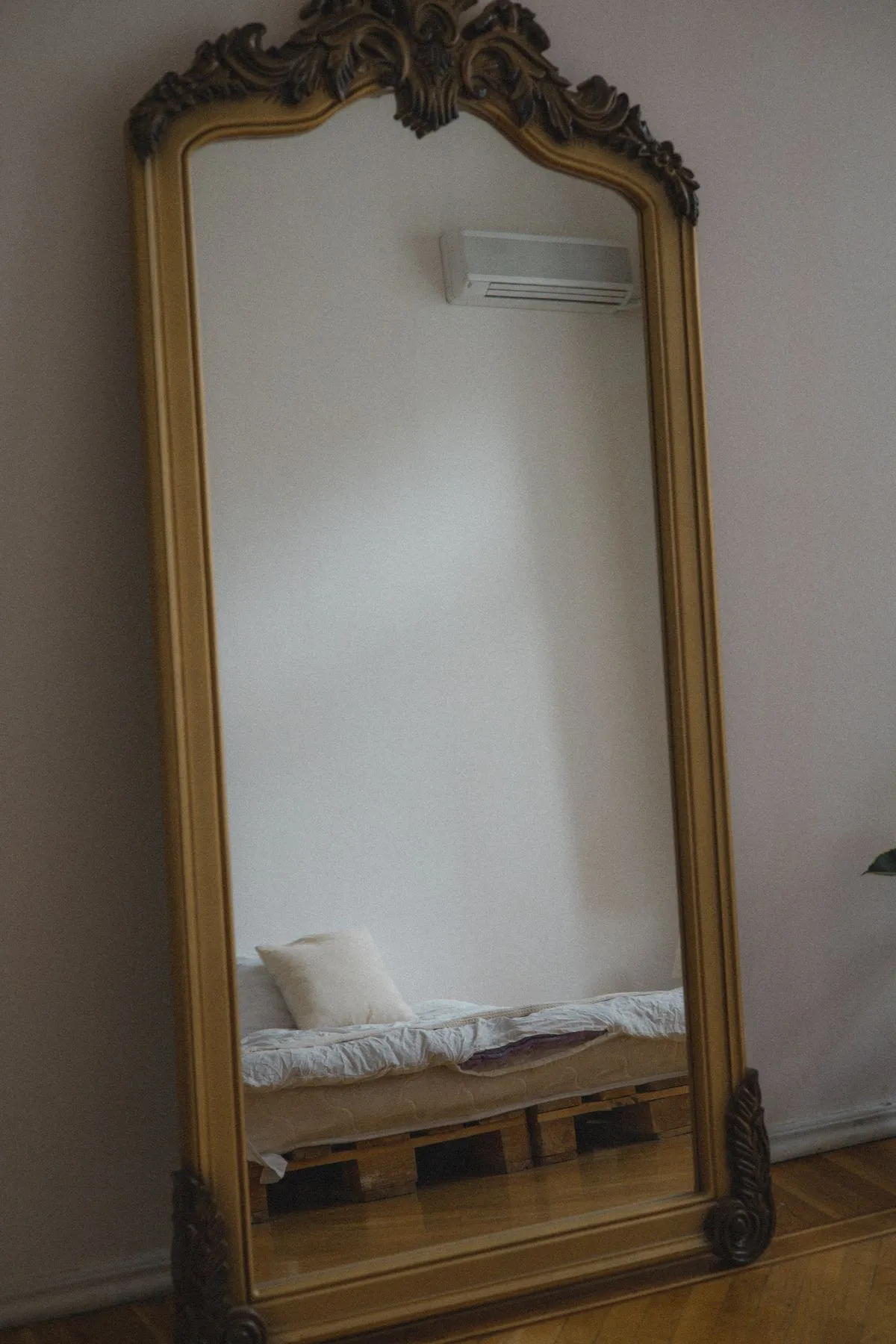
In feng shui, mirrors are treated as active tools, not passive decoration. They’re understood to reflect and circulate energy (chi) rather than simply bounce light — which is exactly why they’re prized in some placements (a mirror in a dark hallway, reflecting a beautiful view) and considered disruptive in others.
The bedroom is meant to be the one space in a home dedicated to rest, stillness, and recovery. A mirror facing the bed introduces movement and duplication into a room whose entire purpose is the opposite of that. Traditionally, this is described as creating a “third party” presence in the room — an extra reflected energy competing with the stillness sleep requires.
The Sleep-Specific Concern
Beyond the general energy explanation, there’s a more specific, more commonly cited concern: waking suddenly in a dark room and catching an unexpected reflection of yourself can genuinely startle the nervous system, even after you consciously register what it is. Feng shui practitioners have long pointed to this as a real, physical disruption to the deep, restorative quality of sleep — not just a symbolic one.
This is part of why the mirror-facing-bed rule tends to be treated more seriously than most other bedroom mirror placements. It isn’t only about circulating energy in the abstract; it’s about a specific, repeatable disturbance to the one activity the bedroom exists for.
There’s also a relationship-specific version of this concern that comes up often for couples. A mirror facing the bed is sometimes described as introducing a symbolic “third presence” into the relationship — an extra reflection in a space meant to hold just two people. Whether or not that resonates for you personally, it’s part of why this particular placement gets singled out more than most other feng shui bedroom guidance.
Does This Apply to Every Type of Mirror?
Not equally. A large mirror that fully reflects your sleeping body is treated as the most significant concern. A small decorative mirror, or one angled away from the bed, carries much less weight. The guiding question is simple: if you’re lying in bed in your usual sleeping position, can you see a full reflection of yourself? If yes, that’s the placement worth addressing.
It helps to actually check this rather than estimate it from memory. Lie down in your normal sleeping position for a moment during the day and look around deliberately — many people are surprised to find a partial reflection they’d never consciously noticed, simply because they’re usually asleep or getting up quickly rather than lingering in that exact spot.
Common Bedroom Mirror Placements Worth Reconsidering
A few placements come up again and again as the ones people don’t realize count:
- A dresser mirror directly across from the bed. Often the biggest offender, since dressers are usually placed for convenience without considering the reflection angle.
- A mirrored closet door facing the bed. Common in smaller bedrooms or older homes, and easy to overlook since it’s built into the furniture rather than freestanding.
- A full-length mirror leaned against a wall opposite the bed. Frequently placed there simply because it’s the only open wall, without factoring in the reflection.
- A mirrored ceiling fixture or decorative panel. Less common today, but considered the most disruptive placement when it does occur.
- A mirrored wardrobe running the length of one wall. Common in built-in storage solutions, and often the hardest to address simply because it covers so much surface area.
- A vanity or makeup mirror positioned at the foot of the bed. Frequently added for convenience during a room’s original design, without anyone considering the sightline from a resting position.
It’s worth doing a slow walk-through of your own bedroom with this list in mind. Most people are surprised to realize they’re affected by more than one of these at once, simply because none of them were placed with the bed’s sightline in mind to begin with.
What to Do Without Renovating
The good news is that fixing this doesn’t require moving furniture permanently or spending money on renovations. A few practical options work well:
- Reposition the mirror, if it’s freestanding. The simplest fix — angle it toward a wall or a different part of the room instead of the bed.
- Cover it at night. A curtain panel, a folding screen, or even a decorative throw draped over the mirror before bed addresses the concern completely while you sleep, and can be uncovered again during the day.
- Add removable frosted film for fixed mirrors. For mirrored closet doors that can’t be moved, a removable static-cling frosting film reduces the reflection significantly without any permanent change, and comes off cleanly if you move out.
- Reposition the bed instead, if that’s easier. Sometimes shifting the bed a few feet, or angling it, removes the direct reflection without touching the mirror at all.
- Choose furniture placement with this in mind going forward. Once you’re aware of the rule, it becomes an easy thing to factor into any future bedroom rearrangement.
When It’s Not Practical to Change Anything Right Away
If you’re renting, sharing a room, or simply not in a position to make any changes soon, it’s worth keeping this in perspective: feng shui guidance is meant to support your wellbeing, not become another source of stress. A single night with a mirror facing your bed isn’t going to undo your sleep quality on its own.
If a full fix isn’t possible yet, even a temporary measure — draping a scarf over the corner of the mirror closest to your reflection, or repositioning your pillow so you’re not in the direct sightline — reduces the effect meaningfully until a better solution is available.
It’s also worth noting that intention matters here more than perfection. Consciously acknowledging the placement and choosing a small, imperfect fix tends to shift how a room feels far more than most people expect, even before the “ideal” solution is in place. Feng shui, at its core, rewards attention and small deliberate choices over grand, one-time overhauls.
A Simple Bedroom Energy Check
Beyond the mirror itself, it’s worth taking a broader look at how your bedroom supports rest. A few questions to sit with:
- Can you see a full reflection of yourself from your normal sleeping position?
- Is your bed in direct line with the bedroom door?
- Is there clutter accumulating under or around the bed?
- Does the room feel calm when you walk in, or does something feel slightly “off” that you haven’t named yet?
None of these require an expert to assess — the sense of ease or unease you already feel in the room is usually the most reliable signal, with feng shui simply giving that feeling a specific vocabulary and a specific fix.
Treat this list as a starting point rather than a strict inspection. The goal isn’t to achieve a perfectly “correct” bedroom by some external standard, but to notice where your own space might be quietly working against the rest it’s meant to support — and to address those spots one at a time, without pressure to fix everything at once.
This same idea — that your surroundings can either support or quietly work against your emotional state — shows up throughout the Zodiac hub as well; your moon sign shapes the emotional environment you’re most sensitive to, which is worth factoring in alongside your physical one. And if disrupted sleep has been leaving you with unusually vivid dreams, our guide on dreaming about someone before you meet them covers what those might actually mean.
Once your bedroom mirror is sorted, it’s worth extending the same attention outward — to the placement of rose quartz for love in the same room, and even to what your front door color is doing before energy ever reaches the bedroom at all.
For more ways to align your home with rest, love, and calm, visit the Feng Shui hub.
Frequently Asked Questions
Is it really bad to have any mirror in the bedroom, or just one facing the bed?
It's specifically about the bed. A mirror elsewhere in the bedroom — on a closet door to the side, for instance — is generally fine. The concern in feng shui is a mirror directly reflecting the bed itself, especially the sleeping body.
What if my closet door mirror faces the bed and I can't move the closet?
You don't need to move it. Covering the mirror at night with a curtain, screen, or removable cling film addresses the concern without any renovation, and is the most common fix recommended in feng shui practice.
Does a mirror on the ceiling above the bed count too?
Yes — a ceiling mirror is considered the most disruptive placement of all, since it reflects the sleeping body directly and constantly. It should be addressed the same way as a wall mirror, ideally removed or covered.
What about a mirror on a wardrobe that only partially reflects the bed?
Partial reflection is treated more gently than a full, direct reflection, but if you can see any part of yourself lying in bed from your usual sleeping position, it's worth applying the same fix.
Are there other common feng shui mistakes in the bedroom besides mirrors?
Yes — a bed positioned directly in line with the door, sleeping under exposed heavy beams, and clutter under the bed are the next most commonly cited issues, though the mirror facing the bed tends to be the one with the most consistent agreement across different schools of feng shui.