The Tower, Death, and The Devil: Tarot's 'Scary' Cards Explained
The Tower, Death, and The Devil look frightening, but none of them mean what they seem to. Here's what each card actually means in a reading.
Few moments in a tarot reading land quite like pulling a card that looks genuinely alarming. A tower struck by lightning, figures falling through the air. A skeletal figure on horseback. A horned, chained figure looming over two smaller ones. If you didn’t know better, you’d assume these three cards — The Tower, Death, and The Devil — were about the worst things a reading could tell you.
They aren’t. All three are among the most misunderstood cards in the deck, largely because their imagery was designed to be dramatic long before anyone considered how unsettling that drama would feel to a beginner encountering it cold. Here’s what each one actually means.
The Tower
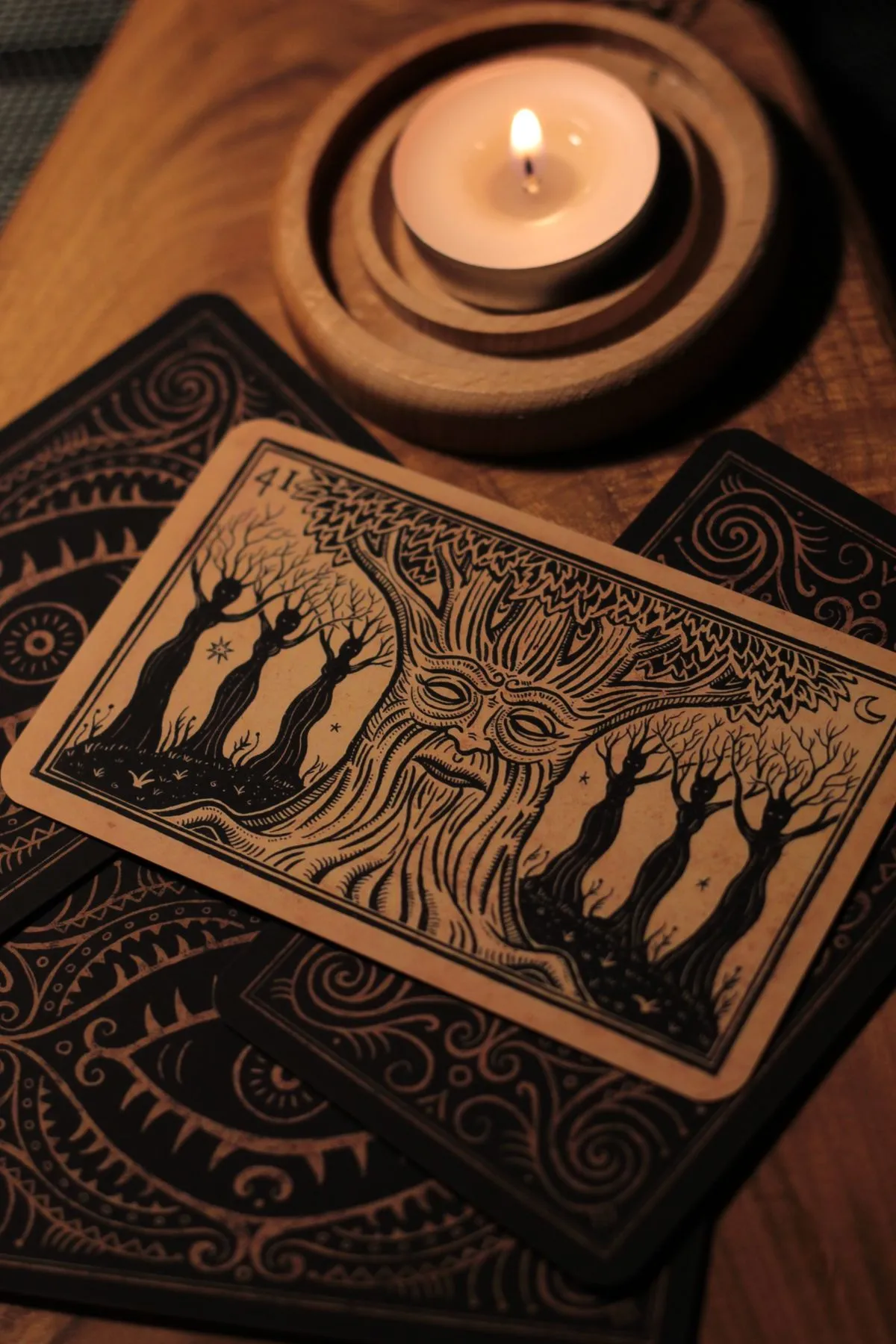
The Tower depicts a tall structure struck by lightning, its crown knocked loose, figures falling from the wreckage. It’s arguably the single most visually dramatic card in the entire deck — and that drama is doing exactly what it’s meant to do.
The Tower represents sudden, unavoidable upheaval — but specifically the kind that clears away something that was never actually stable to begin with. The structure the card shows collapsing wasn’t secure; it was built on a shaky foundation, and the lightning strike is less a random catastrophe than an overdue correction.
In a reading, The Tower tends to show up when a situation, belief, or relationship is about to be disrupted in a way you can’t control or delay — but the disruption is generally read as clearing space for something more honest and stable to be rebuilt in its place. It’s rarely described as destruction without purpose.
It’s worth noting that The Tower is also one of the few Major Arcana cards where the timing is described as largely outside your control. Unlike cards that point to a choice you’re making, The Tower tends to describe something that’s going to happen regardless — which is part of why it can feel unsettling, but also why resisting it tends to be less useful than preparing for what it clears away.
Why The Tower Feels So Much Worse Than It Is
Part of what makes The Tower frightening is that it depicts the moment of collapse itself, rather than what comes after. Readers unfamiliar with the card tend to fixate on the falling figures and miss that the surrounding cards in a spread almost always clarify what’s being rebuilt, not just what’s being lost.
Death
The Death card shows a skeletal figure, often on horseback, moving through a scene of change. It’s the card most people already associate with tarot before ever picking up a deck, thanks to how often it’s depicted (usually inaccurately) in movies and television as a literal death omen.
In actual tarot practice, Death is read almost universally as a card of transformation and ending — closing one chapter so a new one can begin. It’s about release rather than loss: a relationship, job, identity, or way of living that has run its course and needs to end for something else to take its place.
Death is also one of the more forgiving cards in terms of timing. Unlike The Tower’s abrupt, uncontrollable shift, Death often points to an ending that’s already been building for a while, one you may have sensed coming even if you haven’t consciously named it yet. The card, in that sense, tends to confirm rather than announce.
Why Death Rarely Means What Pop Culture Suggests
Tarot as a symbolic system draws heavily on transformation and cycles — death and rebirth as a metaphor, not an event. Professional readers treat a literal-death interpretation of this card as a beginner’s misunderstanding almost without exception, precisely because the entire tradition the card comes from treats endings as generative rather than final.
The Devil
The Devil card shows a horned, seated figure with two smaller figures chained loosely beneath it. Unlike The Tower or Death, this card’s discomfort comes less from dramatic imagery and more from what it implies about the person pulling it.
The Devil represents self-imposed limitation — attachment, addiction, a toxic pattern, or a situation you feel trapped by, even when the chains in the image are loose enough to imply the figures could simply walk away. That detail is deliberate: The Devil is rarely about external forces controlling you. It’s about the ways you may be limiting yourself, often through fear, habit, or comfort with something familiar even when it isn’t serving you.
Where The Tower and Death both describe change that’s largely underway or unavoidable, The Devil is different: it’s the one card of the three that puts the choice back in your hands. That’s part of why it can feel more uncomfortable than the other two — it’s harder to feel powerless about a situation the card itself says you have some ability to walk away from.
The Detail Most People Miss
The loosely drawn chains in most versions of this card are the entire point. They suggest the restriction is more perceived than absolute — which is both the card’s most useful insight and, for many people, its most uncomfortable one. It’s easier to be told you’re trapped by something external than to consider that the way out has been available longer than you realized.
Why These Cards Cluster Together in People’s Minds
It’s not a coincidence that these three specific cards get grouped as “the scary ones.” All three depict something visually dramatic (lightning, a skeleton, a devil figure) while carrying meanings that are, in practice, about necessary change rather than doom. The gap between how they look and what they mean is exactly what makes them memorable — and exactly what makes them so often misunderstood by anyone who hasn’t sat with their actual meaning.
Tarot’s earliest imagery was designed in an era that leaned heavily on dramatic, symbolic visual language — the same era that gave religious and allegorical art its own taste for skeletons, devils, and collapsing towers as shorthand for large ideas. Later decks have softened or reimagined this imagery, but the classic versions that most beginners encounter first are still the more visually intense originals, which is part of why the gap between appearance and meaning feels so wide today.
This same gap shows up elsewhere in this site’s approach to seemingly ominous signs — the same reassurance that applies to a mirror facing your bed not being a permanent curse applies here: a dramatic-looking signal usually just means “pay attention,” not “something terrible is guaranteed.”
What to Do When You Pull One of These Cards
- Notice your first reaction, then set it aside. The initial jolt of fear is normal and doesn’t reflect the card’s actual message — let it pass before interpreting.
- Look at the surrounding cards. Context in the rest of the spread almost always clarifies what’s actually ending, changing, or being outgrown.
- Ask what you already suspect needs to change. These three cards rarely introduce a brand-new problem; they tend to name something you’ve already sensed but haven’t fully faced.
- Resist reshuffling to avoid it. As with any card that keeps reappearing, avoidance tends to prolong the discomfort rather than resolve it.
- Revisit the reading after some time has passed. These cards often make more sense in hindsight, once the change or ending they pointed to has had room to unfold.
If a card like this shows up during your own daily single-card practice, treat it the same way you would any other card in that routine — as one day’s message, not a verdict on your whole life.
The Real Takeaway
None of these three cards are telling you something catastrophic is coming. They’re telling you that something is ready to end, shift, or be released — and that the ending, however dramatic it looks on the card, is what actually makes room for whatever comes next. Learning to read past the imagery to the message underneath it is one of the clearest signs of a maturing tarot practice.
The next time one of these three cards turns up in your own reading, it may help to remember that the fear they provoke is almost always larger than the actual message they carry. That gap between the visceral reaction and the calmer meaning underneath it is worth sitting with for a moment before reaching for a guidebook at all.
For more grounded, reassuring guidance through tarot’s more intense cards, visit the Tarot hub.
Frequently Asked Questions
Does pulling Death in a reading mean someone is going to die?
No. In the vast majority of tarot traditions, the Death card refers to symbolic ending and transformation, not literal death. Readers who work professionally with tarot almost universally interpret it this way rather than as a literal prediction.
Is The Devil card evil, or does it mean something is cursed?
No — The Devil represents self-imposed limitation, unhealthy attachment, or a situation you feel trapped in, often by your own choices or fears rather than by any external force. It's a card about a chain you can see and remove, not a curse placed on you.
Why does The Tower look so much worse than what it usually means?
The Tower's imagery (a lightning-struck tower, people falling) is genuinely dramatic, and that drama is intentional — it represents sudden, unavoidable change. But the change it depicts is almost always described as clearing away something unstable, not destruction for its own sake.
If these cards aren't bad, why do they still feel unsettling to pull?
Because their imagery is genuinely striking, and because they often surface right as we're avoiding a hard truth. The discomfort is usually more about timing and honesty than about the card being a bad sign.
Are there other tarot cards that look intimidating but aren't actually negative?
Yes — the Ten of Swords and the Three of Swords are common examples. Both have dramatic, painful-looking imagery but are generally read as marking the low point of a difficulty rather than predicting an ongoing or worsening one.